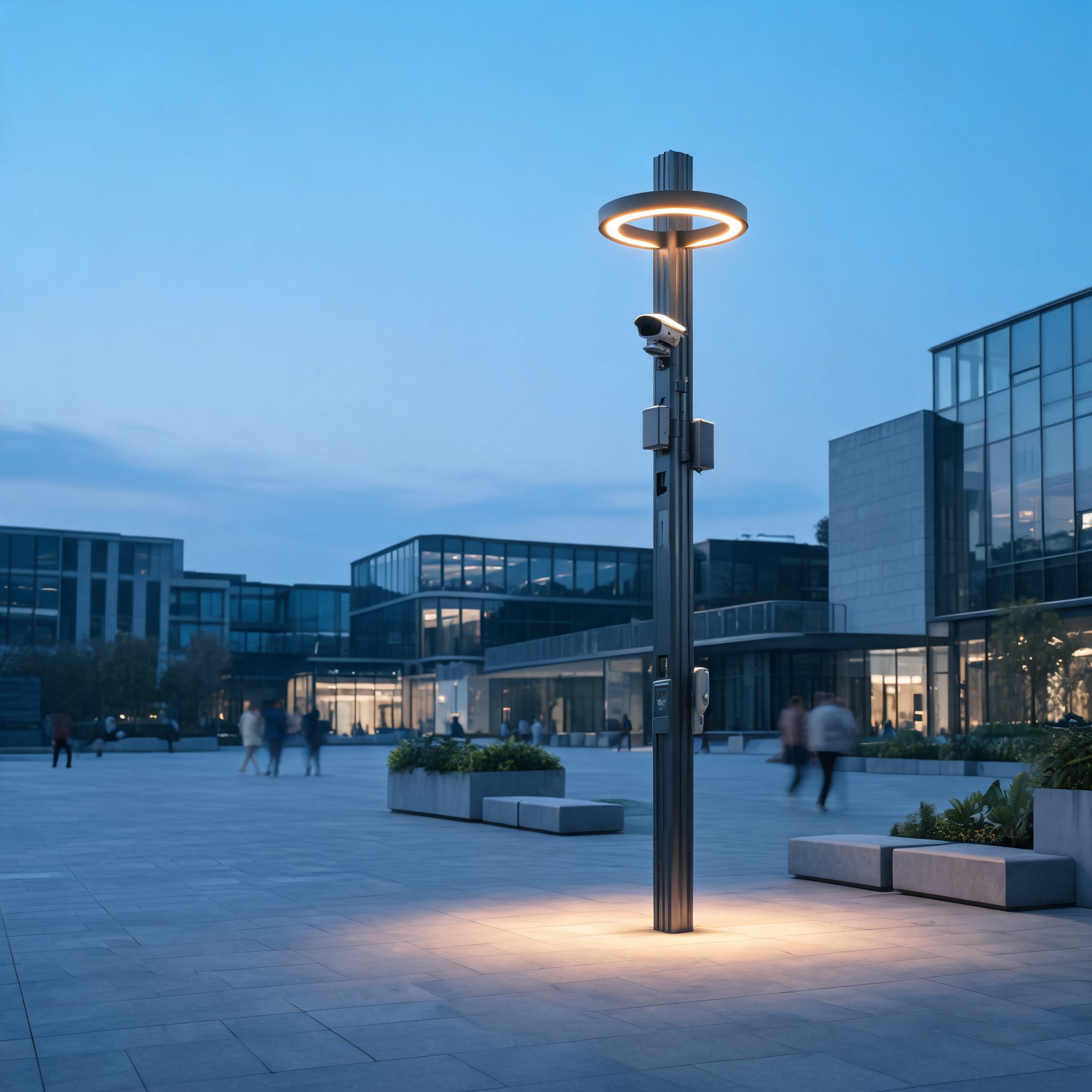
Landscape Forms has relaunched SHUFFLE, a modular smart-pole system that combines connectivity, sensing, lighting and EV-charging capabilities in a single vertical structure. The relaunch targets municipalities, campuses and commercial developers that have been adding separate pole-mounted sensors, cameras, lighting and communications equipment to sites where space is at a premium.
According to the company, SHUFFLE stacks Wi-Fi, cameras, sensors, two-way communications and EV-charging capabilities into one pole that is intended to be easy to activate and install. Its modular components are designed for customization and future adaptability, and the integrated approach is presented as a way to bring modern aesthetics and operational efficiencies into busy, multi-use environments.
New modules and configuration
Feature updates introduced with the relaunch include plug-and-play options: a 360-degree area light, a decorative light ring, a 180-degree area light, quad-view and 180-degree cameras, motion sensors, plus loudspeaker and intercom modules.
Landscape Forms has also added a build feature to its website to simplify configuration. Clients can specify their preferred camera and technology brands and choose among a range of options within each brand.
How the company frames the product
Shannon Lee, Business Development Manager for Smart Poles at Schréder, described the system as the solution site designers have been waiting for. Lee said SHUFFLE is designed to fit the needs of busy public spaces with product and feature sets that can be updated as a site's requirements evolve, and that safety and connectivity are integrated into outdoor spaces without dominating them, keeping the system accessible and user friendly.
Jordan Agustin, President of Lighting at Landscape Forms, said the product represents the kind of thinking the industry needs, with technology and design working together to make outdoor spaces safer and smarter without compromising aesthetics. Agustin said the new features integrated into the streamlined design enhance the beauty and functionality of outdoor space while advancing the company's mission of connecting people to the outdoors and to each other.
Intended settings
The modular design is intended to be configured for specialized environments as well as general public spaces, providing what the company describes as an added measure of security and convenience wherever people gather to work, travel, study and recreate.
Landscape Forms lists university and business campuses, airports and commuting hubs, shopping malls and tourist areas, concert halls, city parks, sports venues and hospitals among the settings the system is meant to serve. The company's stated rationale is that a single integrated pole lets site managers expand site functionality without adding to visual clutter or additional cost; those efficiency and cost benefits are the company's characterization rather than independently verified outcomes.